
Lay betting means betting against a named outcome. Lay a football team to win and you win if it draws or loses. The crucial number is your liability: the money you can lose if that team wins. With a £10 lay stake at decimal odds of 4.00, your normal potential profit is £10 before commission, but your potential loss is £30.
That is the detail to understand before anything else. A tenner in the stake box can look reassuringly familiar. It is not necessarily a tenner at risk.
This guide explains the arithmetic, the football draw that catches people out and the difference between requesting a bet and actually having one. Every price below is a worked illustration, not a live offer or a recommendation.
What is a lay bet?
An ordinary back bet says a selection will succeed. A lay bet takes the other side of that proposition. You are offering someone else a price, not asking a bookmaker to pay you that price.
Imagine a fictional home side called Northbridge. You lay Northbridge in the match-result market. A home win is bad for your bet; a draw or away win is good. You have opposed one result, not selected one alternative winner.
The same distinction applies to a horse in a win market. Laying it is a bet against it winning, not a prediction about which rival beats it. Do not carry that assumption into a place market, where the proposition is different.
For how exchanges themselves work, including liquidity and the difference from a bookmaker, start with our practical guide to betting exchanges. Here, the job is to understand the lay side without the trading jargon.
Lay stake and liability are different numbers
The lay stake is normally the opposing backer's stake: what you can win before commission if your lay succeeds. Your liability is what you owe if the selection wins. Some interfaces also offer a liability-based input, so read the label rather than relying on a familiar screen layout.
For a single fully matched bet at one decimal price, the arithmetic is:
Liability = lay stake × (decimal lay odds - 1).
At 4.00, a £10 backer expects £40 back if successful: their original £10 plus £30 profit. As the layer, you provide that £30 profit. You do not lose £40, and you do not lose only £10.
| Lay stake | Decimal lay odds | Selection loses: gross profit | Selection wins: loss |
|---|---|---|---|
| £10 | 1.50 | £10 | £5 |
| £10 | 2.00 | £10 | £10 |
| £10 | 3.00 | £10 | £20 |
| £10 | 4.00 | £10 | £30 |
| £10 | 6.00 | £10 | £50 |
| £10 | 11.00 | £10 | £100 |
These are normal win/loss outcomes before commission, with no other bets in the market. Special settlement can change them. Decimal odds below 2.00 produce liability smaller than the lay stake; above 2.00, liability is larger. At 2.00 they are equal. There is no mysterious exchange surcharge hiding in that relationship. It is simply the backer's potential profit viewed from the other side.
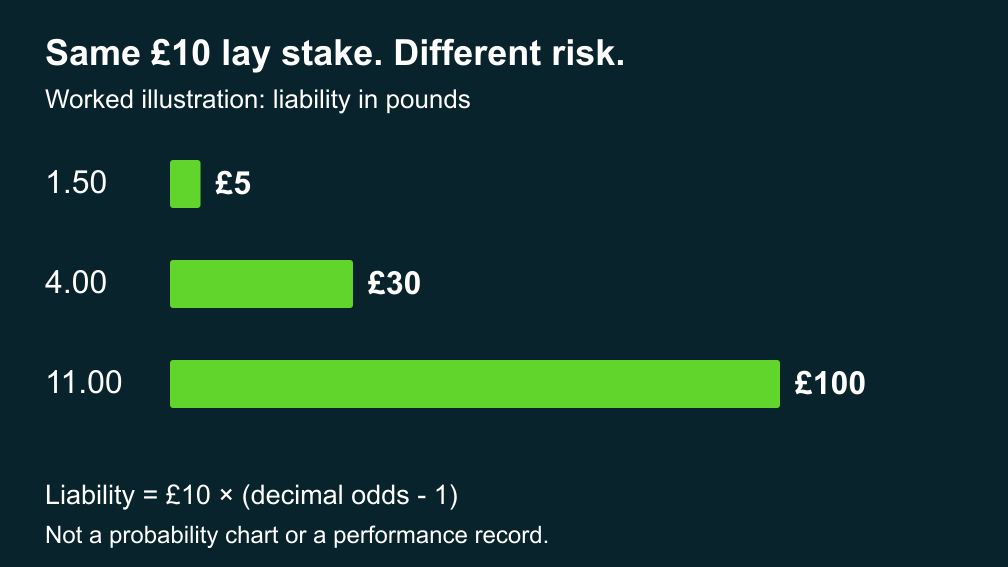
The chart is a risk comparison, not a forecast. A taller bar does not tell you how likely a selection is to win. It shows what one losing lay would cost under these assumptions.
Compare bets with the same amount at risk
Keeping the lay stake at £10 while changing the odds quietly changes the size of the bet. For a fairer risk comparison, start with a fixed liability instead.
Lay stake = chosen liability ÷ (decimal lay odds - 1).
Suppose the maximum loss in a worked example is £20. At 2.00, that corresponds to a £20 lay stake. At 3.00 it is £10. At 6.00 it is £4.
| Decimal odds | Fixed liability | Corresponding lay stake | Gross profit if the lay wins |
|---|---|---|---|
| 2.00 | £20 | £20 | £20 |
| 3.00 | £20 | £10 | £10 |
| 5.00 | £20 | £5 | £5 |
| 6.00 | £20 | £4 | £4 |
| 11.00 | £20 | £2 | £2 |
The risk stays still; the possible reward changes. That is the comparison a fixed-stake table cannot give you on its own.
It also exposes a common trap. A horse at a long price may lose frequently, but laying it for a substantial stake creates a substantial liability. The occasional winner can be expensive. “It probably won't win” is not a complete assessment of a bet.
These amounts are arithmetic examples, not recommended staking levels. Set any gambling limit around money you can afford to lose, including the full liability, rather than the amount you hope to collect. Our bankroll management guide covers the wider discipline.
Is laying a team the same as backing its opponent?
Not in a three-way football match-result market. There is a draw in the middle, and it matters.
| Normal-time result | Lay Northbridge to win | Back the away team to win |
|---|---|---|
| Northbridge win | Losing bet | Losing bet |
| Draw | Winning bet | Losing bet |
| Away win | Winning bet | Winning bet |
That middle row is the entire argument. You cannot compare the two prices as though they buy the same result.
The winning outcomes of laying the home side resemble the away-or-draw option in double chance betting, but prices, commission and contractual rules still need comparing. Matching the outcome set does not mean two bets deliver the same financial return.
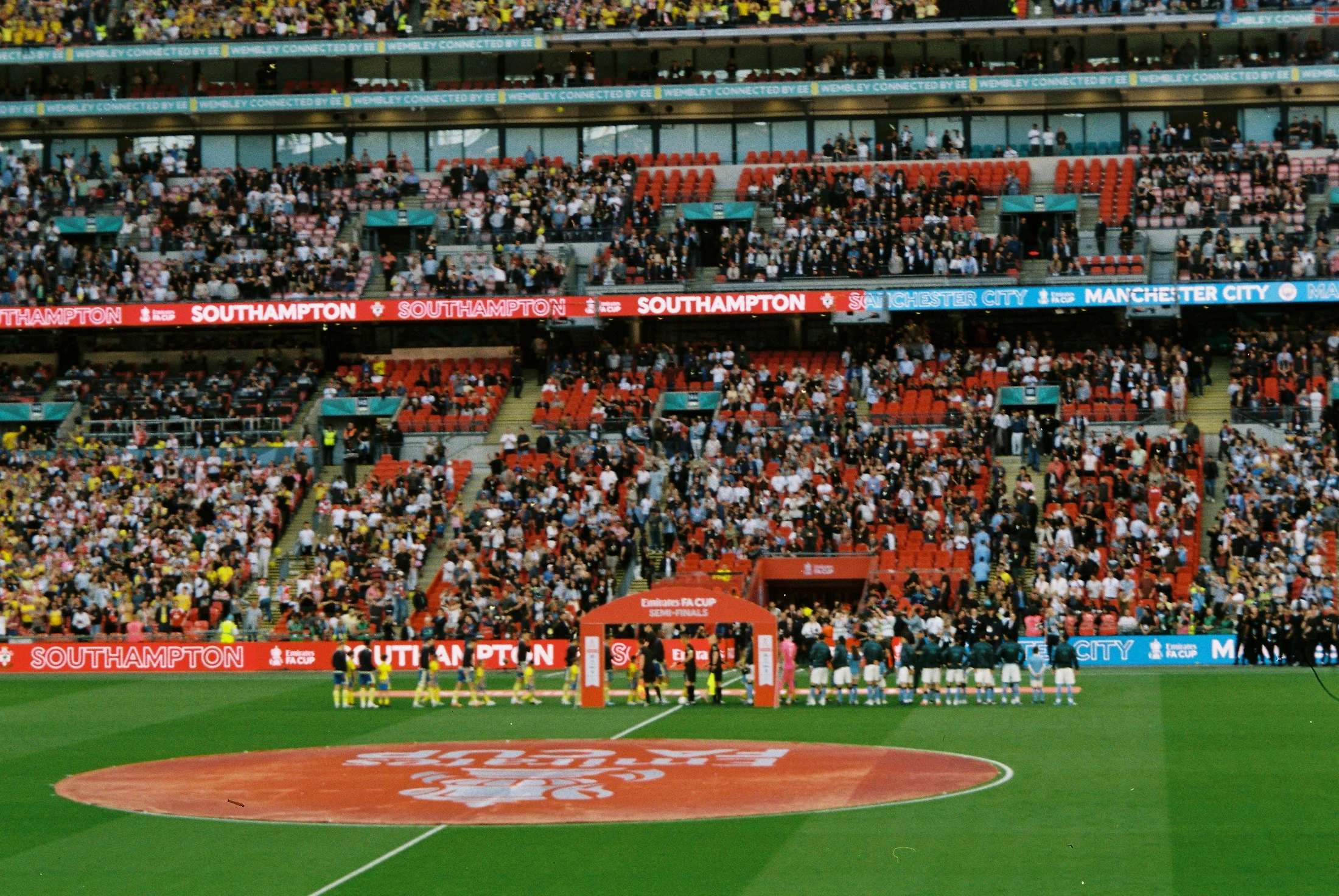
A cup fixture adds another question. Are you opposing a team winning the normal-time match, or opposing it qualifying? Those are not interchangeable. A side can draw after normal time and then progress. The photograph is a useful reminder that a recognisable match is not enough: you need the exact proposition on the bet slip.
What does commission do to a lay bet?
Consider one isolated lay with a £10 stake and £30 liability. If it succeeds, the £10 is gross profit, not necessarily what you keep.
For an illustrative 2% commission rate, £10 gross profit becomes £9.80 net profit: £10 minus £0.20. If the lay loses normally, the loss in this example is £30. The 2% is an assumption for the calculation, not a claim about your account's rate.
Where commission is charged on net market winnings, other bets in the same market matter. Suppose one settled position contributes £10 profit and another contributes £6 loss. Net market winnings are £4. At the same illustrative rate, commission is £0.08, leaving £3.92. Charging £0.20 to the winning leg without considering the losing leg would give the wrong answer under that model.
Check the exchange's current terms and your applicable rate. Additional account charges or different products are outside this simple example. A net-market model is not permission to assume every platform calculates every charge identically.
Requested, matched and partly matched
A price on screen is an invitation to trade, not proof that your whole request has been accepted. The useful evidence is the confirmed matched amount and the price attached to it.
Suppose you request a £10 lay at 4.00 and only £4 is matched. That matched part carries £12 liability and can win £4 before commission. The remaining £6 is still a request, not another completed £18 of exposure at that instant. It could match later if left active.
| Part of the request | Stake | Liability at 4.00 | What it means |
|---|---|---|---|
| Already matched | £4 | £12 | This portion is an accepted bet |
| Still unmatched | £6 | £18 if matched | This portion can still change your exposure |
| Entire request, if all matched | £10 | £30 | Do not assume this has happened |
If the remainder instead matches at 4.20, calculate each fill: £4 × 3.00 gives £12, and £6 × 3.20 gives £19.20. Total liability is £31.20, not £30. Actual accepted prices matter more than the price you remember seeing first.
Smarkets says a matched bet cannot simply be cancelled. Cancelling an unmatched remainder does not erase the part already accepted. Its handling of unmatched orders also has a keep-in-play option, so do not assume every outstanding request disappears at the start.
Closing a matched position involves another transaction or a facility that places one, where available. It is not an undo button. Our cash out unavailable guide explains why an exit should never be treated as a promise.
Why a high strike rate can mislead
Laying can produce an attractive-looking run of small wins. It can also concentrate the damage in a small number of losses.
Take ten hypothetical fully matched lays, each with a £10 stake at 6.00. Nine win and one loses. Before commission, the nine winners produce £90 and the loser costs £50, leaving £40. Change only the results to eight winners and two losers: £80 minus £100 leaves a £20 loss.
There is no historical performance claim here. The point is that an 80% strike rate can lose money under perfectly ordinary arithmetic. A results record needs stakes, liabilities, prices, costs and every losing bet, not just an impressive percentage.
Nor does a favourable-looking price prove you have an advantage. Estimating the chance of the opposed outcome is a separate, difficult job. Understanding the mechanism prevents a mistake; it does not manufacture a profitable strategy.
Check the market before the match starts
Before judging the numbers, check that you are reading the right market, selection and settlement period. Exchange and sportsbook rules can differ even under the same operator's name. Horse-racing withdrawals, dead heats, abandoned events and other exceptions need their actual rules, not the ordinary win/loss formula above.

If you choose to bet, check the liability before confirming, then the matched amount afterwards. Do not increase it because an earlier bet lost. Betting is for adults aged 18 and over, and an exchange is still gambling, not an income plan. Our responsible gambling section provides further guidance and support routes.
The question to take away is not “how much am I staking?” It is “what can I lose, and what exactly has to happen for that loss?” If either answer is unclear, stop there.
Frequently asked questions
Can I lose more than my lay stake?
Yes. In a single normal-settlement lay at decimal odds above 2.00, liability exceeds the lay stake. A £10 stake at 4.00 carries £30 liability. Read the confirmed liability rather than assuming the stake is the maximum loss.
Do I win a lay bet if the match is drawn?
If you lay a team to win in the normal-time three-way match-result market, a draw is a successful lay. If you lay the draw itself, a draw is a losing lay. The selection and market determine the answer.
Is lay betting the same as matched betting?
No. Lay betting describes taking the opposing side of a selection. Matched betting commonly combines separate back and lay positions, often involving an offer. That adds terms and execution risks; a standalone lay is not automatically matched betting.
Are all the prices in this guide decimal?
Yes. The liability formula here uses decimal odds. Do not insert fractional odds unchanged. For example, 3/1 is decimal 4.00, so a £10 lay stake carries £30 liability in the ordinary example.
Is laying safer than backing?
Neither label establishes safety. Compare the maximum loss, possible reward, market rules and your understanding of the bet. A small lay stake can carry a much larger liability, and a high winning percentage can still produce a loss.
Hero photograph: Chelsea v Liverpool, September 2019, by @cfcunofficial (Chelsea Debs) London.
Licence: CC BY-SA 2.0.
creativecommons.org/licenses/by-sa/2.0/
Resized and minimally cropped by BetOwl; adapted photograph shared under the same licence. Archive imagery, no endorsement implied. Full source provenance is retained in the image record.