
The afternoon perfection nearly ended
The number 54 makes Kincsem look invulnerable. It is neat, complete and almost too polished to belong to a living animal: 54 starts, 54 victories, no second places and no defeats.
Her 39th race was not neat at all.
At Baden-Baden in September 1878, the Hungarian mare reached the winning post alongside Prince Giles the First. For the first time in her career, the judge could not separate her from another horse. A dead heat did not count as defeat, but it left the contest unresolved. The prize could be divided, or the two horses could race again.
Kincsem had already spent the summer travelling across Europe. She had won the Goodwood Cup in England, crossed to France and taken the Grand Prix de Deauville, then moved east for the Grosser Preis von Baden. She had nothing left to prove about courage or durability. Her owner, Ernő Blaskovich, chose the run-off.
The two horses went back to the start and did it again. This time there was no shared verdict. Kincsem won by five lengths.
That single afternoon contains the real story of the mare whose name means "My Treasure" in Hungarian. The unbeaten record was not protected by keeping her at home, choosing one type of race or retiring when the number became impressive. It was carried through railway stations, unfamiliar stables, changing distances, rising weights and one finish so close that she had to win the race twice.
The legend says she travelled with a cat and once refused unfamiliar water. Those details have outlived many of the horses she beat. They are charming, but the documented achievement is stranger than the folklore: between the ages of two and five, Kincsem raced in 12 cities across six countries and came home unbeaten every time.
A Hungarian horse built from English blood
Kincsem was foaled in 1874, when organised racing in Hungary was still comparatively young. Count István Széchenyi had helped establish the sport in the country earlier in the century, not simply as entertainment but as a way to improve breeding and strengthen a national equestrian culture. Imported English thoroughbreds became part of that project.
Kincsem's pedigree carried the connection plainly. Her sire, Cambuscan, had been bred in Britain and was a son of Newminster. Her dam, Water Nymph, descended through Cotswold and Melbourne. The mare who would become a Hungarian national symbol was not an alternative to the English thoroughbred tradition. She was one of its most extraordinary European outcomes.
She belonged to Blaskovich, a Hungarian breeder whose name has been rendered in several forms in English reports. Robert Hesp, an Englishman based in Hungary, trained her. This was already an international story before the travelling began: English blood, an English trainer, a Hungarian owner and a filly raised to compete across the racing centres of continental Europe.
Later retellings often begin by calling the young Kincsem plain, awkward or unwanted. The problem is that the anecdotes become more confident the further they move from the surviving record. It is safer to begin with what happened when the racecourse finally asked the question.
On 21 June 1876, Kincsem made her debut at Berlin over 1,000 metres. She won. Eleven days later she won at Hanover, then at Hamburg, Doberan, Frankfurt and Baden-Baden. The campaign continued through Sopron, Budapest, Vienna and Prague.
Ten races in a two-year-old season would be demanding even without the travel. Kincsem won all ten in five different territories of Europe.
That was not a protected introduction. It was an itinerary.
The map matters as much as the total
Modern unbeaten horses are often admired partly because perfection is so fragile. A slow start, unsuitable ground, an awkward passage or a rival enjoying the race of its life can end it. Connections therefore choose targets carefully, and the best horses may race only a handful of times in a season.
Kincsem's career belonged to another age. She started 17 times as a three-year-old in 1877, winning races now described as Hungarian Guineas, Oaks and St Leger equivalents, as well as the Austrian Derby and the Grosser Preis von Baden. She won over distances from a mile to two miles and carried through a campaign that repeatedly put her back on trains and into strange surroundings.
The raw seasonal record is almost difficult to absorb.
| Season | Starts | Wins | The shape of the campaign |
|---|---|---|---|
| 1876, aged two | 10 | 10 | Debut in Berlin, followed by a sweep through Germany, Hungary, Austria and Prague |
| 1877, aged three | 17 | 17 | Classic victories, the Austrian Derby and her first Grosser Preis von Baden |
| 1878, aged four | 15 | 15 | Goodwood, Deauville and the Baden-Baden dead heat and run-off |
| 1879, aged five | 12 | 12 | A final unbeaten season and a third Grosser Preis von Baden |
Some of the 54 were walkovers, because rivals did not always appear to oppose her. That is part of the record and should not be hidden. It does not make the other races disappear. She met male and female opposition, carried substantial weights and won major contests in several racing cultures.
The changing locations are important because they remove the easiest explanation for dominance. Kincsem was not merely the best horse in one stable, on one circuit or under one familiar set of conditions. The Federation of Hungarian Horse Breeders records the achievement as 54 undefeated races in 12 cities and six countries. The geographical spread is the part a bare win total cannot show.
Each new border also enlarged the risk. Railway travel was slower, horseboxes less sophisticated and veterinary support less advanced. A horse could not be told why the water, feed, noises and people had changed again. The same mare who had to settle into each new place was then expected to produce the same answer on the track.
She did.
The summer Britain had to believe
By 1878 Kincsem had won 36 races, yet an undefeated record built largely in central Europe still invited an English reservation. Britain considered itself the centre of thoroughbred racing. If the Hungarian mare was exceptional, she could come and demonstrate it at Goodwood.
The journey brought its own complications, but the test on 1 August became smaller before the runners reached the start. Verneuil, an important French rival, was withdrawn after a problem with his hock. Kincsem faced only two opponents in the Goodwood Cup.
That context matters. Beating two horses after the most dangerous rival had been scratched is not the same as defeating a deep field. Nor was Goodwood an empty formality. Pageant was a respected stayer in good condition, the distance was more than two and a half miles, and Kincsem was racing far from the system that had supported her first 36 victories.
An 1878 report described the Hungarian visitor as a nut-brown chestnut standing about 16 hands one inch, with a deep brisket, powerful hindquarters and notably sound knees and hocks. The writer did not pretend she possessed every fashionable refinement. Her usefulness was visible in the parts that drove her forward and kept doing so.
Kincsem won by two lengths.
Goodwood's own history still identifies her as arguably the most famous horse ever to race there. That judgment is striking because the course has seen generations of British champions. Kincsem appeared once, won its great staying prize and left behind a result the racecourse still uses to describe itself.
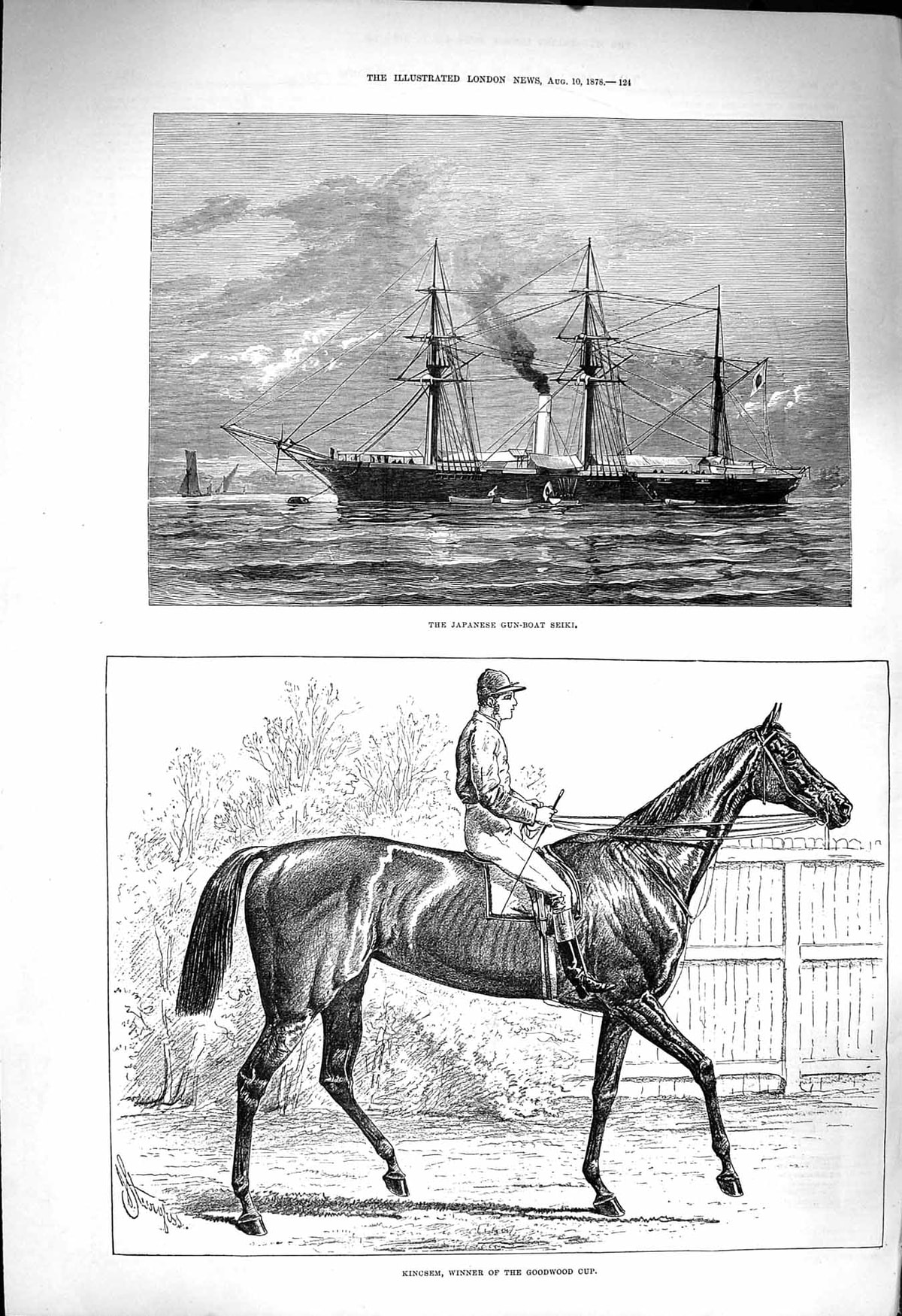
Seventeen days later she raced at Deauville. The field was larger, the distance shorter and the opposition French. She won the Grand Prix de Deauville, then travelled towards Baden-Baden for the race that would come closest to leaving a mark in the wrong column.
This sequence is why Kincsem's 1878 summer matters more than the easy slogan of 54 out of 54. England, France and Germany each offered a major prize within a little over five weeks. She did not select one and return home. She won all three.
When a win required a second win
At Baden-Baden, Kincsem carried more weight than she had at Goodwood and faced four rivals. Prince Giles the First stayed with her to the post. The dead heat created the only moment in her entire career when victory was not immediately hers.
There is a useful distinction here. Officially, a dead heat was not a loss. Had the owners divided the prize, Kincsem could still have retired unbeaten. But unbeaten and victorious are not quite the same promise, and her career had been built around the second word.
The run-off settled it.
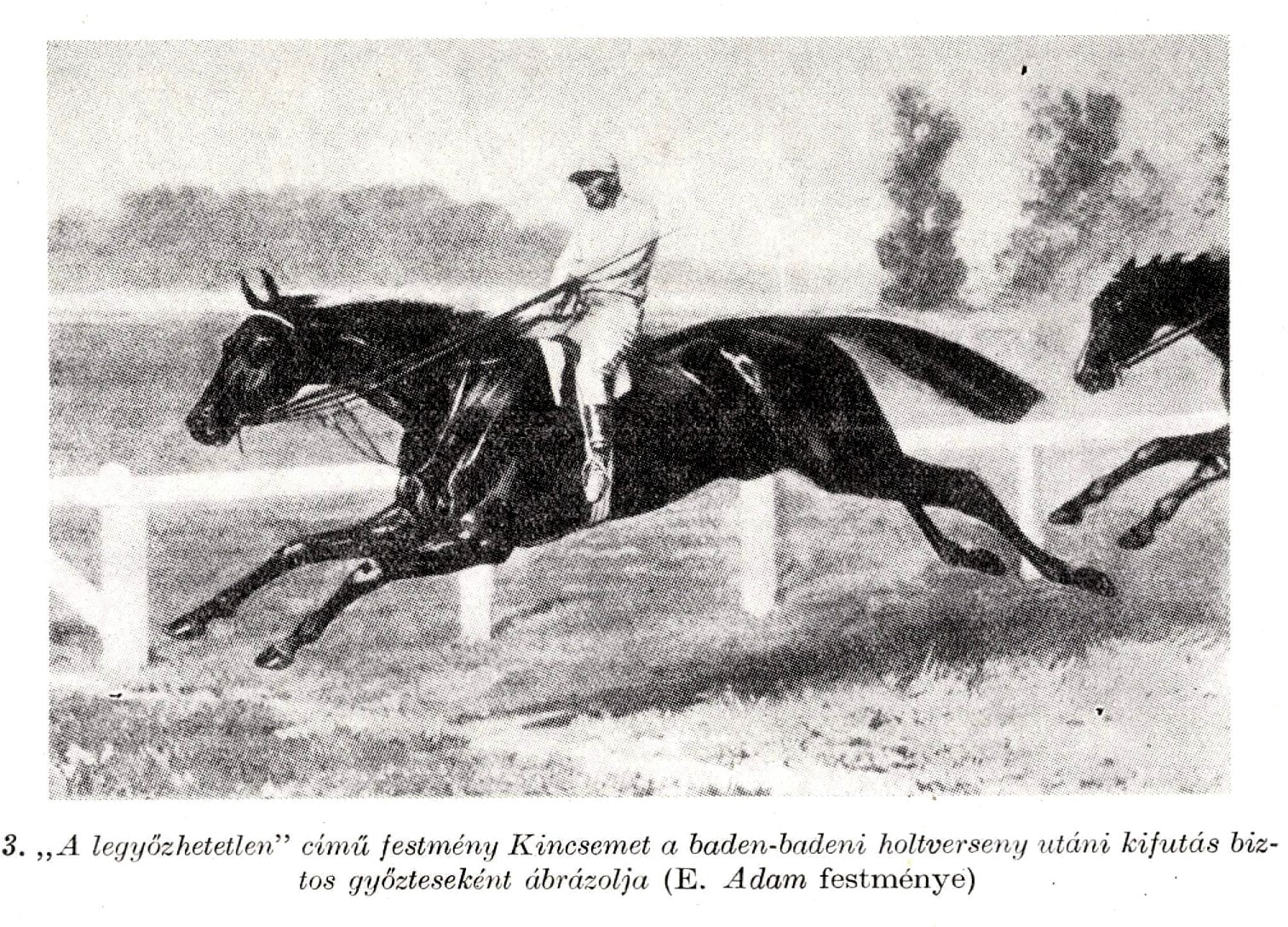
The image that survives shows Kincsem stretched low in full flight, the other horse behind her. It is an artist's rendering rather than a photograph, but it captures the right historical fact: the perfect record passed through a tie, and the response was another race.
Kincsem completed the season with 15 wins from 15 starts. At five she returned for 12 more, including a third consecutive Grosser Preis von Baden. Her last race came at Budapest in October 1879. The final total stopped at 54 because her racing career stopped, not because another horse had found a way past her.
The cat, the water and the problem with perfect stories
Every sporting life that reaches this distance from its own time acquires a second record: the things people want to believe about it.
Kincsem is said to have travelled with a black-and-white cat, often named as Csalogány, and to have become distressed when the companion went missing. Another story says she refused to drink unfamiliar water at Baden-Baden until a suitable source was found, later remembered as Kincsem's well. She was reportedly particular about her surroundings and deeply attached to the routine built around her.
There are period images and longstanding Hungarian traditions linking Kincsem, Hesp and the cat. The precise dialogue and dramatic details that appear in modern retellings are harder to verify. The water story has also accumulated different versions.
This does not require the folklore to be thrown away. It requires it to be labelled.
The stories endured because they give an apparently mechanical record a personality. Fifty-four victories can turn a horse into a machine in the reader's mind. A travelling companion and a preferred drink return her to the world of animal habits, trust and unease. They remind us that every train journey in the official record was experienced by a horse who could not understand the number being protected.
The mistake is to treat the charming anecdotes as proof of her greatness. Kincsem does not need them. The evidence is the race programme, the contemporary reporting and the map.
What 54 victories do not mean
Comparing champions across centuries is usually a way to flatten all of them. Kincsem did not face modern starting stalls, modern training methods or an internationally standardised pattern of Group races. Some of her contests were small, several were walkovers and the quality of opposition varied.
Frankel's unbeaten 14-race career belongs to a different sport in almost every practical sense. Black Caviar's 25 victories were built around elite sprinting. Eclipse, Ormonde and other historic champions carried their own eras and conditions. A numerical comparison cannot decide which horse was "best" without pretending that distance, opposition, travel, weight and time are interchangeable.
Kincsem's claim is narrower and, properly understood, more impressive. No other recognised thoroughbred has assembled a longer undefeated sequence than her 54 victories. She did it across four busy seasons, over varying distances and across much of European racing.
The number is not a universal rating. It is a record of survival without surrender.
The life after the winning stopped
Retirement changed Kincsem's purpose but not her importance. She became a broodmare and produced five foals, with her descendants extending the story into later generations of thoroughbreds. Hungary placed her name on its principal racecourse in Budapest, while museums, monuments and breeding institutions preserved her as more than an old results line.
She died in March 1887, just before her 13th birthday. The career had lasted only four seasons; the legend had already begun while she was still alive.
That contrast explains why Kincsem is famous in Hungary and oddly unfamiliar to many British racing followers. British memory naturally organises itself around the Derby, Grand National, Cheltenham and Royal Ascot. A visitor who came to Sussex once can sit outside that structure, even when she won one of Goodwood's greatest races and carried a record no British champion has matched.
The gap is exactly where forgotten sporting stories live. It is not that the achievement disappeared. Hungary never forgot her. Goodwood still names her. Racing historians still preserve the 54. What faded was the connection between those facts and the wider British audience that once watched her arrive.
BetOwl's horse racing coverage usually deals with the sport in front of us, while the Betting Academy explains the decisions behind a wager. Features such as Britain's forgotten 1938 baseball world champions serve another purpose. They recover the competitors who do not fit neatly into the familiar calendar.
Kincsem fits nowhere neatly.
She was bred in Hungary from English blood, trained by an Englishman and proven in Germany, Austria, France and Britain. She was a mare in an era whose histories were more often written around stallions. She was both a national treasure and a relentless traveller. Even her closest brush with imperfection became two entries in the same afternoon: dead heat, run again, win.
The answer every city received
There is a temptation to end with the cat or the water because those are the details that make an old horse seem close. But Kincsem's finest characteristic may have been the one no anecdote can improve.
She kept arriving.
Berlin asked first, when she was two. Hanover, Hamburg, Doberan and Frankfurt followed. Vienna and Budapest asked repeatedly. Goodwood asked whether central European form could travel west. Deauville asked whether she could recover in 17 days. Baden-Baden asked the only question another horse managed to leave open, then asked it once more before the afternoon was over.
Fifty-four starts can be reduced to a statistic. They can also be seen as 54 separate occasions on which transport, health, ground, weight, tactics and opposition had the chance to break a perfect line.
None did.
The legends gave Kincsem a cat, a favourite source of water and the affectionate name "My Treasure". Racing gave her six countries and four seasons in which to lose.
She never used them.
Explore more overlooked sporting lives in the complete BetOwl article archive, or return to the latest racing and sports features.