
The throw that went wrong
With two men out in the 15th inning of the 1938 British Challenge Cup final, Ross Kendrick was still pitching. He had worked through the afternoon at Spotland without allowing a walk and had given up only five hits, yet Oldham and Rochdale remained locked at 0-0 when a weak ball rolled back towards him. Kendrick gathered it and threw to first. The ball sailed beyond the first baseman's glove, the runner came home and a cup final that had lasted 15 innings was over.
Kendrick had struck out 20 men. His own error had lost the match 1-0.
A lesser sporting story might have ended there, with the pitcher carrying the blame and everybody else carrying the cup away. This one had barely begun. Five days later an American team stepped ashore at Plymouth; two days after that, Kendrick stood on the mound at Wavertree in a white England shirt, facing the country that had given baseball to the world.
Across the next seven days, England played the United States in Liverpool, Hull, Rochdale, Halifax and Leeds. The home side won four games out of five, Kendrick did not concede a run in 18 innings as a starting pitcher, and a group of largely Canadian sportsmen became the first champions of the competition later known as the Baseball World Cup.
Britain had beaten America at baseball. Then, almost as remarkably, Britain forgot.
That is the irresistible outline, but outlines are often where forgotten teams are trapped. They preserve the score and lose the people. The fuller story belongs to a red-haired 24-year-old captain, a pitcher seeking an answer to the worst throw of his summer, an outfielder who would later fly with the Dambusters and a collection of football and rugby league grounds briefly given over to another country's summer game.
Baseball in the spaces between seasons
British baseball in 1938 was neither a novelty act nor a national obsession. It lived in the space between those things, sustained by promoters who saw empty summer terraces, northern clubs that wanted a spectacle and Canadian athletes who could play baseball when the ice-hockey season was over.
John Moores, the Littlewoods businessman, had spent much of the decade trying to make the game pay. Professional and semi-professional leagues appeared in London and across the north; football and rugby league grounds provided the stages, while recruited North Americans supplied a standard of play worth charging to watch. There had been crowds in the thousands and the suggestion of a new British sporting habit, but by 1938 attendances were weakening, the London professional league had folded and the northern game had contracted.
Across the Atlantic, former Major League player Leslie Mann was pursuing a grander argument. Baseball had appeared at the Berlin Olympics in 1936 before a crowd reported at more than 100,000, although Japan's withdrawal meant the intended international demonstration became a match between two American teams. Mann wanted the sport recognised as international and, eventually, Olympic. To prove it, he needed countries rather than exhibitions.
The 1940 Games were due to take place in Tokyo, where baseball was expected to return, but Japan relinquished the Olympics in July 1938 as war spread through China. An American amateur squad had already been assembled for a European journey, leaving Moores and Mann with players, ambition and a tour in search of meaning. Their solution was a five-match series in England, carrying a trophy supplied by Moores and the hope that other nations would join in years to come.
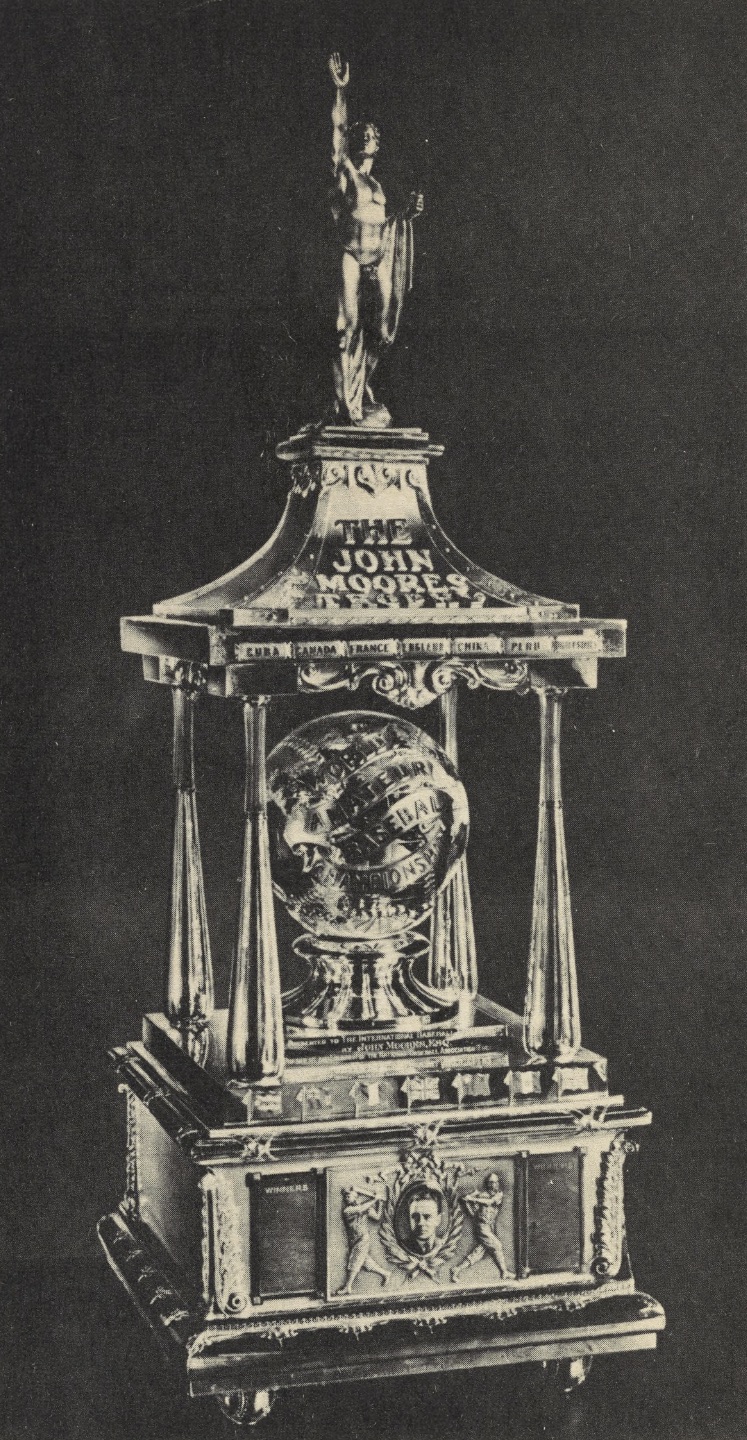
The cup looked as though it had arrived from a much older tradition. Four bats supported its bowl; a ball sat at the base; a baseball player stood on top. Moores imagined an international prize on the model of tennis's Davis Cup, and the first contest was called the International Amateur Baseball Championship.
The world-title language was not a modern embellishment added after everyone involved had died. When Cuba staged the next championship in 1939, the 1938 series was recognised as the first World Amateur Baseball Championship. It was a beginning rather than the mature global tournament that later editions became, but the elevation happened while the victory was still recent news.
Twelve men in England shirts
The team photograph survives in black and white. Twelve players stand shoulder to shoulder, most with gloves at their sides, their pale uniforms carrying a Union emblem over the heart. A young batboy, almost swallowed by his cap, stands at the front. Behind them, the crowd dissolves into the grain.
Contemporary newspapers and programmes called them England; modern records list Great Britain. Almost all had learned their baseball in Canada, a fact sometimes used to turn the achievement into a technicality, as though the players had wandered off an American ship and borrowed matching shirts. Their real journeys were more interesting.
Canada was a Dominion within the British Empire, and Canadian-raised athletes already represented Britain under the eligibility conventions of the time. The ice-hockey team that won Olympic gold for Great Britain in 1936 had relied heavily on British-born players developed in Canada. British baseball drew from the same movement of people, but also from a commercial link between winter ice rinks and summer ball fields: the men who came to Britain to play hockey often brought another game with them.
George "Chummie" McNeil was one of them. A red-haired Nova Scotian of Scots descent, he had come to England for ice hockey and made himself useful almost everywhere on a baseball diamond. He was only 24 when appointed England's player-manager, yet a contemporary profile described a quiet, unassuming leader who could draw the "last ounce" from his players. He would play third base in the series, catch when required and make the decisions that mattered most.
Danny Wright, born in Ontario to English parents, captained and coached Halifax. He held open practices at Spring Hall, helping to turn imported knowledge into a local club, and possessed a temper as conspicuous as his power. Larry Marsh was another Montreal sportsman, a left-handed hitter who could catch, pitch or roam the outfield. Jerry Strong, Ross Kendrick, Irvine Ruvinsky and Frank Cadorette carried more Canadian baseball experience into the side, alongside Sid Bissett, Sam Hanna, Ken Robinson, Jack Ritchie and the reserve catcher known as Doc Holden.
These were not household names and, outside British baseball history, most never became so. They were experienced players inside a functioning domestic culture, good enough to make an American touring side discover that its hosts understood far more than the rudiments.
The Americans were amateurs, not a disguised Major League all-star team. That distinction matters because the dishonest version of a story is always weaker in the end. Mann's squad had been chosen with the abandoned Olympic project in view, and it included Mike "Lefty" Schemer and Mizell "Whitey" Platt, both of whom would later reach the Major Leagues. England was not facing Joe DiMaggio; neither was it playing a ceremonial collection assembled to lose politely.
Ross Kendrick's second chance
Before the opening international, the Oldham press had already tipped Kendrick for England. McNeil knew about the 15 innings, the 20 strikeouts and the throw that had escaped him in the Challenge Cup final, then gave him the ball anyway.
Around 10,000 people came to Wavertree on Saturday 13 August. Kendrick and the American pitcher Virgil Thompson carried a scoreless game into the bottom of the seventh, which meant every England batter had spent the afternoon waiting for one clean opening. Wright found it first, driving a home run that broke the deadlock; Sam Hanna followed with a double and Marsh singled, helping England stretch the inning to three runs.
Kendrick protected them all. He finished with a two-hit shutout and 16 strikeouts, a performance so dominant that the simple score, England 3, United States 0, still understates the shock. Seven days after his error had decided one final, his right arm had decided an international.
There is no need to invent what he felt, because his pitching supplies the answer that sentiment usually tries to provide. He had been trusted after a public mistake, returned to international duty one week later and overwhelmed the American batting order. Sport rarely offers redemption in such a tidy span of time.
Five grounds, seven days
The championship had no single final and no settled home. It travelled through the north, asking the players to recover, move and begin again, while every ground gave the game a different frame.
| Date | Venue | Result | Defining detail |
|---|---|---|---|
| 13 August | Wavertree Stadium, Liverpool | England 3-0 USA | Ross Kendrick allowed two hits and struck out 16 |
| 15 August | Old Craven Park, Hull | England 8-6 USA | Jerry Strong struck out 12 as England survived a closer contest |
| 16 August | Spotland, Rochdale | USA 5-0 England | Clyde Dean delivered the American side's only win and shutout |
| 18 August | The Shay, Halifax | England 4-0 USA | Kendrick's second shutout secured the championship |
| 19 August | Headingley, Leeds | England 5-3 USA | Rain and poor light ended the finale after six innings |
Hull hosted the second match on Monday, and the series immediately became less orderly. The Americans scored first, England answered with five runs in the fifth inning and the lead tightened again before the home side held on 8-6. Strong struck out 12. After two games in three days, the country that was supposed to demonstrate baseball to Europe found itself 2-0 down.
At Spotland the following evening, with the weather uncertain and England changing its pitching, the visitors finally imposed themselves. Clyde Dean shut out the hosts 5-0 before a crowd of about 1,000. The result altered the tone of the series: what might have been remembered as two startling afternoons had become a contest again, and the Americans had a route back into it.
That route ended at The Shay on Thursday. McNeil returned to Kendrick, who allowed only three singles and struck out 12 as England won 4-0. McNeil contributed a home run, but the deeper satisfaction must have been in his first decision, the one made before Wavertree when he trusted a pitcher still carrying the error at Spotland. Kendrick's two starts now amounted to 18 scoreless innings, five hits and 28 strikeouts. The championship was secured with one match left.
Headingley supplied an unruly epilogue. A Leeds Mercury reporter wrote that cries of "Let's go!" were drummed into his ears for two hours as players and spectators disputed decisions and the Americans comfortably won the contest for noise. Strong pitched the first four innings, Kendrick the last two, and England led 5-3 when rain and poor light ended the match after the sixth.
The final aggregate was England 20, United States 14. More important than the arithmetic was the repetition: the Americans had been given five games, five grounds and several chances to adjust, yet England had beaten them four times and shut them out twice.
The lives beyond the photograph
A team picture gives everybody the same uniform and almost the same amount of space. Life did not.
McNeil moved to Scotland for the 1938-39 ice-hockey season, later coaching and managing Falkirk Ice Rink. He married, raised a family and eventually moved to the United States in 1956. His baseball captaincy, for all its historical weight, became one part of a sporting life spent helping other teams function.
Kendrick settled near Birmingham after the Second World War and worked as an electrician. He helped establish local clubs and continued playing into his sixties, giving British baseball something less dramatic but perhaps more necessary than another shutout: continuity. He died in 1975 and was inducted into the British Baseball Hall of Fame in 2009.
Wright's trail becomes harder to follow. The Halifax coach who hit the home run at Wavertree served as an army private during the war and became a prisoner in Germany; his later life has resisted the researchers who recovered so much of the 1938 team. That uncertainty should remain uncertainty. A forgotten sportsman does not become ours to complete with guesswork.
Marsh's story travelled furthest from the diamond. He joined the Royal Air Force Volunteer Reserve, became a pilot and served with 617 Squadron, the Dambusters. On 12 November 1944 he took part in Operation Catechism, the attack that sank the German battleship Tirpitz, and was later awarded the Distinguished Flying Cross. He returned to Montreal after the war and died in 1987.
The temptation is to present these afterlives as proof that the team was secretly full of extraordinary men. That would miss the gentler truth. Like most squads, it contained lives that grew vivid in different ways and memories that faded at different speeds. Baseball joined them for one week in 1938, just before history scattered them.
The summer that did not lead to another
The new championship travelled to Cuba in 1939. Britain, the defending champion, did not go, and within weeks the Second World War began. The Tokyo Olympics were cancelled, organised sport was transformed and the North American recruitment network that had raised the level of British baseball was broken.
The domestic game survived through clubs, volunteers and service teams, but it never regained the same place in the national sporting imagination. Football, cricket and rugby reclaimed the grounds. A crowd of 10,000 watching Kendrick at Wavertree became harder to imagine than the result itself, while the John Moores Cup preserved the beginning of an international competition whose future would be written elsewhere.
Great Britain did not return to the Baseball World Cup until 2009. That 71-year absence turned the champions into an isolated photograph rather than the first chapter of an unbroken tradition.
Yet the line has not disappeared completely. Great Britain reached the World Baseball Classic for the first time in 2023 and beat Colombia; in March 2026 it returned to the tournament, defeating Brazil 8-1. The under-23 side had already supplied an even closer echo in 2025, recovering from 7-0 down to beat hosts Czechia 9-7 in the European Championship final, the programme's first European gold and its first international gold medal since 1938.
Modern British baseball has different eligibility rules, development systems and pressures, and it deserves coverage on its own terms. BetOwl will follow that story in US Sports, while longer accounts of overlooked competitors and uncommon sporting histories belong in Other Sports alongside the wider daily mix on the News page. The connection to 1938 is not a claim that nothing has changed; it is a reminder that British baseball has surprised the country before.
The photograph that waited
Look again at the old team picture and it becomes difficult to see only a curiosity. Kendrick is there before two international shutouts and decades spent keeping the game alive in Birmingham. McNeil is there at 24, trusted with a national side before his life in Scottish ice hockey. Wright is there before the home run, the war and the gaps in the record; Marsh before 617 Squadron and the Tirpitz.
They are wearing England shirts because that was the name used in their own summer, though history now files them under Great Britain. They are mostly Canadian-raised because British sport between the wars moved through the Empire, the shipping routes and the ice rinks as well as through birthplace. They are world champions because the organisers of the next tournament recognised their five-match series as the first of its kind.
None of this makes Britain a lost baseball superpower. It makes the achievement smaller, stranger and more human: twelve men found by a fragile domestic game, carrying complicated identities into borrowed grounds, were good enough to beat the United States four times in a week.
The cup survived. The scores survived. For years, the story barely did.
Then there is the photograph, holding the players together after their lives had carried them apart. A line of white uniforms, gloves hanging at their sides, faces turned towards a camera whose operator is no longer known. They had no way to know that war would close the world they were playing in, or that Britain's first baseball championship would also be its last for generations.
They only knew that America had come, and that they were ready.