
An ante-post price can look marvellous right up to the moment your horse goes somewhere else. The race is months away, the odds are generous and the trainer has several possible targets. Only one of those things is printed in large type on the betting slip.
An ordinary ante-post bet usually loses if the horse does not run. Non-Runner No Bet, or NRNB, returns the stake on a qualifying non-runner single. In a multiple, a void selection normally drops out and the remaining selections continue. The market terms on the accepted receipt decide which arrangement you bought.
That distinction matters more than whether you placed the bet early. Two prices offered for the same horse on the same afternoon can carry different non-runner conditions. The larger number is not necessarily the better deal.
What ante-post betting actually means
Ante-post markets let you bet on a future race before its ordinary final-declaration market. You might be backing a horse for a spring festival during the winter, or for a Classic before its final preparation. The exact market transition is an operator rule, not a universal number of days before the race.
Under the usual all-in terms, reaching the start is part of your risk. Injury, a different target or unsuitable ground can leave a losing bet without a race to watch. Your horse winning another contest does not rescue a ticket naming the one it missed.
The attraction is a price that may shorten as more becomes known. The complication is that the same new information can make the ticket worthless. A promising performance can improve the price story while doing nothing to settle the target.
Do not confuse an entry with a commitment. An entry provides an option; a declaration provides stronger evidence of intention; neither should be turned into a personal guarantee that the horse will start.
NRNB protects participation, not performance
NRNB changes the non-runner condition. It does not promise that the horse will run well, finish the course or win. If it participates and loses, an ordinary win bet loses.
Some bookmakers use the label Non-Runner Money Back, or NRMB. Read the actual conditions rather than assuming that similar labels have identical coverage.
| What happens to the selected horse? | Ordinary all-in ante-post single | Qualifying NRNB single |
|---|---|---|
| Runs and wins | Paid at the accepted price, subject to the applicable settlement terms | Paid at the accepted price, subject to the applicable settlement terms |
| Runs and loses | Stake lost | Stake lost |
| Is withdrawn before taking part | Normally stake lost | Stake returned |
| Runs in a different race instead | Normally stake lost on the named race | Normally void if it does not participate in the named race |
| Comes under orders but refuses to race | Check runner status and any concession | Check runner status and any concession; NRNB is not a universal refusal refund |
| Race is abandoned or materially changed | Separate ante-post cancellation conditions apply | Separate race-cancellation conditions apply |
The final two rows are where shorthand becomes dangerous. A horse that refuses to start can fall under a different rule from one withdrawn beforehand. Our horse-refusal guide explains that boundary. If the problem has already happened, use what happens when a horse is withdrawn to follow the relevant settlement route.
The bigger price has to pay for the extra risk
Consider an entirely invented choice: 12/1 ante-post or 8/1 NRNB, with a £10 win stake. If the horse runs and wins, the first ticket returns £130 and the second £90, including the stake. If it does not run, the ordinary ante-post ticket returns nothing and the NRNB single returns £10.
The extra £40 on a winner is easy to see. The price of the missing refund is less obvious.
For an illustration, suppose you estimate a 10% chance of winning if the horse runs. That is a made-up input, not an assessment of a real horse. We can then vary the assumed chance of participation while keeping the same conditional winning chance.
| Assumed chance of running | Average net result: £10 at 12/1 ante-post | Average net result: £10 at 8/1 NRNB | Better of these two model results |
|---|---|---|---|
| 60% | -£2.20 | -£0.60 | NRNB |
| 70% | -£0.90 | -£0.70 | NRNB |
| 80% | +£0.40 | -£0.80 | Ante-post |
| 90% | +£1.70 | -£0.90 | Ante-post |
| 100% | +£3.00 | -£1.00 | Ante-post |
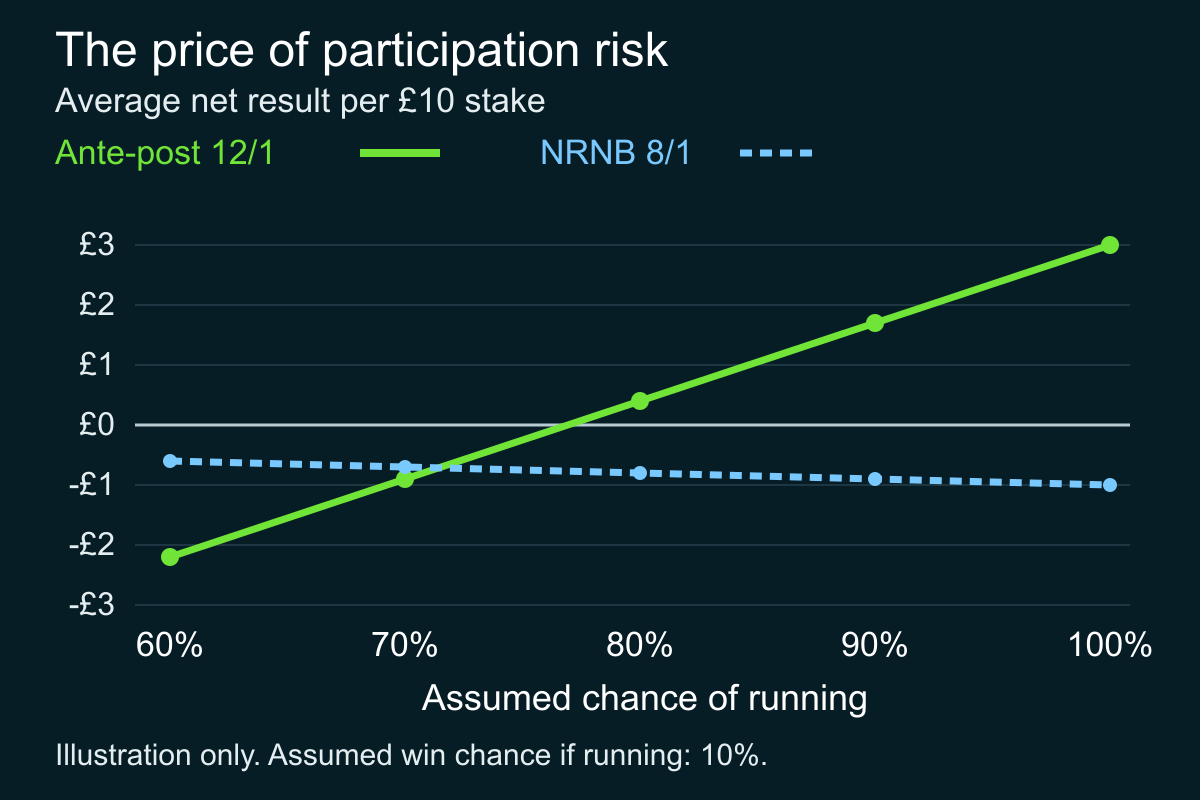
Illustration, not racing data. The model assumes a 10% winning chance conditional on running, ordinary win singles, cash stakes and no deductions or special concessions. It is not a prediction or a record of returns.
At 70%, both choices have a negative model result. Calling NRNB the better of the two does not make it a good bet. Declining both remains an option.
At 80%, the model changes its preference because the larger winning return outweighs the lost non-runner refund. It does not mean that 80% is a sensible estimate for any actual horse. That judgement requires evidence the arithmetic cannot supply.
The small deterioration in the NRNB column is also deliberate. At these invented odds and this invented winning chance, the bet has a negative expectation whenever the horse runs. Making participation more likely creates more exposure to that unfavourable proposition.
How to reproduce the calculation
Write the chance of running as r, the chance of winning if it runs as q, and use decimal odds including the stake.
For the ante-post bet, average net result is stake × (r × q × ante-post decimal odds - 1).
For NRNB, it is stake × r × (q × NRNB decimal odds - 1). The non-running cases contribute zero net result because the stake comes back.
For our example, the two choices are equal at a running probability of about 71.4%: 1 ÷ [1 + 0.10 × (13 - 9)]. That is the crossover between two offers, not the point at which either offer necessarily becomes profitable.
In reality, participation and the horse's likely performance can be linked. Ground that makes it more likely to run may also change its chance of winning. The model holds that relationship still so the price trade-off is visible. Our guide to probability calibration explains why an estimate should be tested rather than merely delivered with confidence.
Check the receipt, not the calendar
Before accepting an early price, identify the exact race, the market label and the non-runner wording. Record the price, stake, date and each-way terms if applicable. Keep the confirmation, particularly when a festival offer is advertised elsewhere on the site.
Three points deserve separate attention.
First, an offer beginning today does not automatically rewrite yesterday's ticket. Some operators may expressly extend protection to earlier bets. Paddy Power's current help wording, for example, describes a refund concession for Future Racing win or each-way bets after the race becomes NRNB. Establish whether that wording covers your accepted bet; do not transfer the concession to another operator.
Second, the selected race matters. Protection for one festival race is not a promise to transfer your selection to whichever race the trainer eventually chooses.
Third, a refund condition and a price condition are separate. NRNB does not itself mean Best Odds Guaranteed. A qualifying non-runner refund says nothing about whether a drifting winner will be paid at a larger starting price.
If the label is unclear, ask the operator which non-runner rule applies before placing the bet. There is no benefit in discovering the contract after the horse has been withdrawn.
Multiples: a void leg is not a separate cash refund
Imagine a £5 treble at 3/1, 4/1 and 5/1. These are illustrative prices, with no deductions or other settlement adjustments.
If the 4/1 selection is a qualifying NRNB non-runner, the treble normally becomes a £5 double on the other two horses. If both win, the return is £5 × 4 × 6 = £120, including the original stake.
You do not receive one third of the £5 back while the remaining two thirds form a new bet. A multiple is one combined stake. The void leg contributes decimal odds of 1.
If that middle selection instead loses under all-in ante-post terms because it does not run, the treble loses. A winning first and third leg cannot repair it.
The risk gets harder to judge when several future runners have uncertain targets. Multiplying the headline odds does not multiply certainty. Our accumulator margin guide explains another reason a long potential return should not be mistaken for value.
Each-way terms and exceptions still matter
An ante-post each-way ticket contains a win stake and a place stake. A £5 each-way bet costs £10. Under ordinary all-in conditions, a non-runner can lose both parts. A qualifying NRNB each-way single normally returns both.
For a runner, the place fraction and number of places deserve as much attention as the win price. Bet365's ante-post rules specify the price and place terms accepted when the bet was struck. Do not assume a later extra-place promotion has been added to an earlier receipt.
Ordinary ante-post betting also differs from day-of-race betting when a rival is withdrawn. Bet365's stated general ante-post rule does not apply a normal Rule 4 deduction, but its rules set out exceptions, including compulsory withdrawals. NRNB and race-day conditions can involve deductions. The Rule 4 guide explains the calculation without treating every early bet as the same product.
Postponement, abandonment, a change of venue and a horse being balloted out are not interchangeable events. An ante-post ticket may stand through a postponement while another defined change makes it void. Check the precise clause rather than relying on the slogan that ante-post bets always lose when a horse does not run.
The decision before the decision
The first question is not whether 12/1 looks better than 8/1. It is what you must be right about to collect.
With an ordinary ante-post bet, you are accepting uncertainty about both participation and performance. NRNB removes a specified part of the first risk, usually at a different price. Neither contract removes the possibility of losing when the race is run.
Read the terms, save the receipt and distinguish an attractive number from an attractive proposition. There is no obligation to make either bet.
18+. These examples explain settlement and arithmetic, not a recommendation to gamble. Only use money you can afford to lose, never increase stakes to recover losses, and see our responsible-gambling information if betting is becoming difficult to control.